A Canticle for Leibowitz Review
Hot!!!
Special Price Here
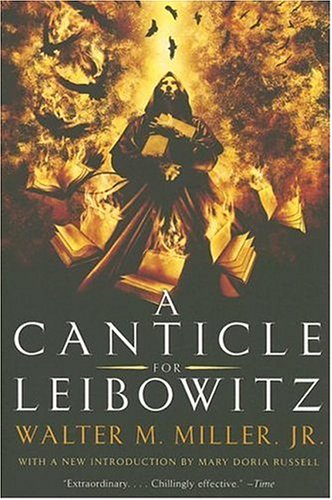
"A Canticle for Leibowitz" is a post-nuclear holocaust drama set primarily within the walls of a Catholic monastery in the middle of what was once the United States of America. It is divided into three parts, roughly six centuries apart, beginning about six hundred years after a global nuclear event. The story finds the monks of a religious order striving to preserve knowledge and culture (as had been the case in the middle ages) in the hope that it will benefit humanity at some future date when mankind once again attempts to establish an ordered and (hopefully) just civilization--at least more ordered and more just than the last. The question which pervades the story is this: Is all knowledge good and therefore worthy of preservation? Or is it possible that the use (or misuse) of some knowledge has led humanity to nearly annihilate itself?
The story is brilliant, down to the final detail. Miller's work is a reflection on humanity's struggle for objective "progress" while, due to his fallen nature, inevitably digressing into a subjective relativism which--though under the guise of service to mankind--is actually oriented to the service of self. Miller's grasp of the nature and purpose of the Catholic Christian Church is exceptional (Miller converted to Catholicism after serving in World War II), and his reflections demonstrate the applicability of "old" (traditional/universal) Christian principles to new scenarios and circumstances. "Canticle" also shows the resilience of ancient heresies in their ability to resurrect themselves with newer, more "sensible" packaging. Miller's characters even muse on the fact that good intentions entered into with complete sincerity are still not sufficient to render an act as "good"; as the Abbot of the monastery reflects, "Perhaps Satan was the sincerest of the lot."
I find no weaknesses in this book to speak of. Some have lamented upon the relatively frequent use of Latin (which is not always translated), though usually its meaning can be gleaned from the context (the reader can also find translations using a search with "Leibowitz Latin translation"). Others have attempted to dismiss Miller's reflections and even Catholicism itself due to the fact that Miller--who suffered from clinical depression--took his own life decades later. This misses the point entirely; humanity's nature is fallen, and even knowledge of the Truth is not sufficient--it is a day to day battle, and in moments of weakness, any of us can succumb to the darkness.
I would not only identify "A Canticle for Leibowitz" as a good read, but a MUST-read for anyone interested in the so called "post-apocalyptic" genre, but even more so for those who themselves desire a deeper reflection on humanity's existential place, purpose, and ultimate destiny.
Other books of similar genre and/or philosophical reflection:
Father Elijah: An Apocalypse
Dominion I: Seed (A 7-book apocalyptic epic)
Saint Leibowitz and the Wild Horse Woman (a sequel published posthumously, though possibly "tainted" by Miller's illness and a second writer)
A Canticle for Leibowitz Feature
- ISBN13: 9780060892999
- Condition: NEW
- Notes: Brand New from Publisher. No Remainder Mark.
A Canticle for Leibowitz Overview
Winner of the 1961 Hugo Award for Best Novel and widely considered one of the most accomplished, powerful, and enduring classics of modern speculative fiction, Walter M. Miller, Jr.'s A Canticle for Leibowitz is a true landmark of twentieth-century literature -- a chilling and still-provocative look at a post-apocalyptic future.
In a nightmarish ruined world slowly awakening to the light after sleeping in darkness, the infant rediscoveries of science are secretly nourished by cloistered monks dedicated to the study and preservation of the relics and writings of the blessed Saint Isaac Leibowitz. From here the story spans centuries of ignorance, violence, and barbarism, viewing through a sharp, satirical eye the relentless progression of a human race damned by its inherent humanness to recelebrate its grand foibles and repeat its grievous mistakes. Seriously funny, stunning, and tragic, eternally fresh, imaginative, and altogether remarkable, A Canticle for Leibowitz retains its ability to enthrall and amaze. It is now, as it always has been, a masterpiece.
A Canticle for Leibowitz Specifications
Walter M. Miller's acclaimed SF classic A Canticle for Leibowitz opens with the accidental excavation of a holy artifact: a creased, brittle memo scrawled by the hand of the blessed Saint Leibowitz, that reads: "Pound pastrami, can kraut, six bagels--bring home for Emma." To the Brothers of Saint Leibowitz, this sacred shopping list penned by an obscure, 20th-century engineer is a symbol of hope from the distant past, from before the Simplification, the fiery atomic holocaust that plunged the earth into darkness and ignorance. As 1984 cautioned against Stalinism, so 1959's A Canticle for Leibowitz warns of the threat and implications of nuclear annihilation. Following a cloister of monks in their Utah abbey over some six or seven hundred years, the funny but bleak Canticle tackles the sociological and religious implications of the cyclical rise and fall of civilization, questioning whether humanity can hope for more than repeating its own history. Divided into three sections--Fiat Homo (Let There Be Man), Fiat Lux (Let There Be Light), and Fiat Voluntas Tua (Thy Will Be Done)--Canticle is steeped in Catholicism and Latin, exploring the fascinating, seemingly capricious process of how and why a person is canonized. --Paul Hughes
Available at Amazon Check Price Now!

*** Product Information and Prices Stored: May 02, 2010 18:00:05

0 ความคิดเห็น